The cuisine of poverty, or why the highlanders ate so modestly
Podhale was never a land of plenty. Poor, stony soil and a harsh, short growing season meant that the fields yielded little. Ethnographers describing highlanders’ households emphasised the almost Spartan monotony of their diet. The larder of the average family was meagre, and the menu was built around a few cheap, filling and, above all, home-grown produce. Nothing could be wasted.
Oats, the true staple of the traditional diet
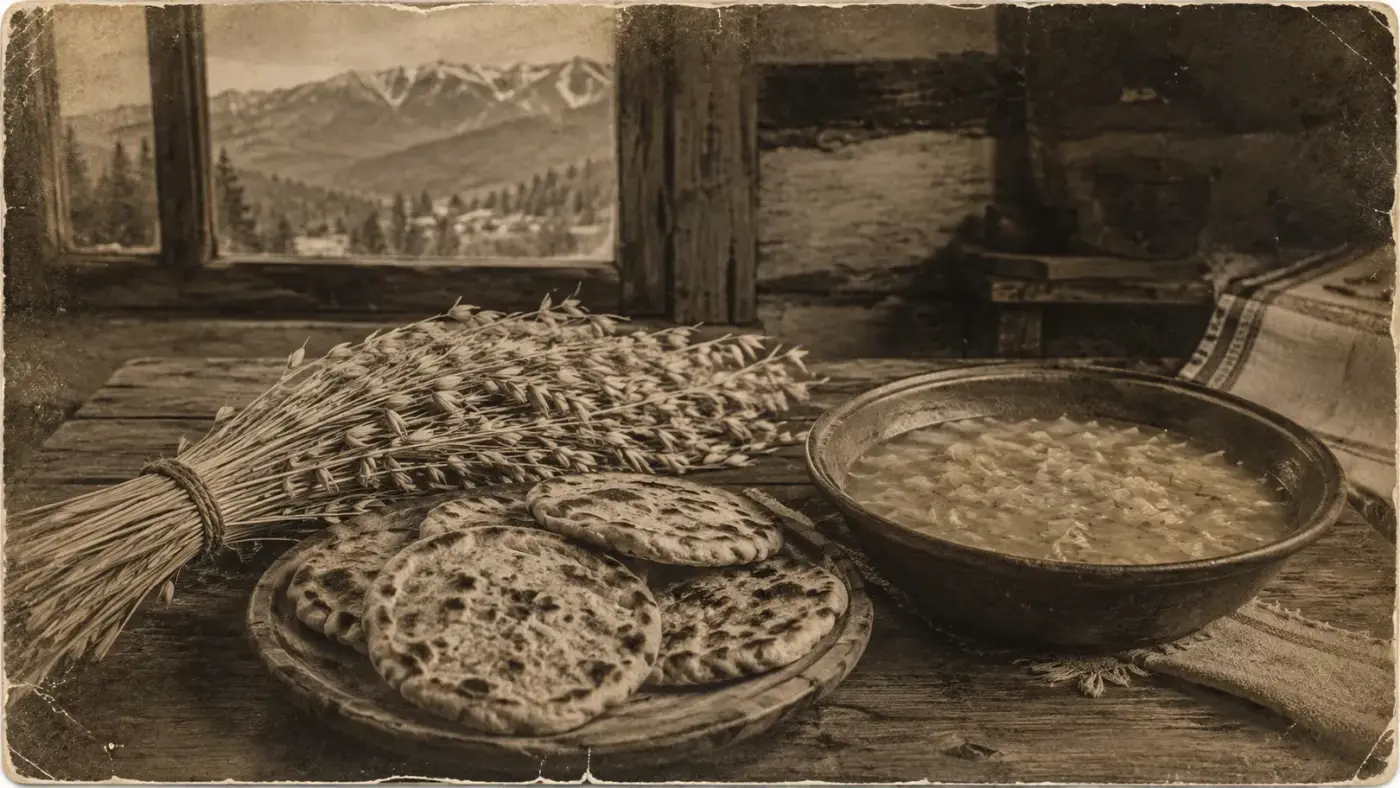
Before the potato took over highlander cuisine, oats were its foundation. This cereal coped best with the mountain climate, so oat flour formed the basis of everyday meals.
Bryjka and oat dumplings
The most common breakfast was bryjka or its thicker variant known as kluska. It was made very simply: oat flour was mixed with hot water and topped with a little ‘omasta’, or fat. It was a warm, thick porridge that provided energy for a long day’s work in the fields or tending the sheep.
Moskole potato flatbreads instead of bread
Wheat or even rye bread was out of the question on a day-to-day basis. Its role was fulfilled by ‘moskole potato flatbreads’, or flatbreads baked on a baking tray without any fat. The later version, known today as ‘moskole potato flatbreads’, is made from boiled potatoes, flour and water, and is eaten with sour soup or cabbage. In 2011, the ‘moskol’ flatbread was added to the Ministry of Agriculture’s List of Traditional Products. There is also a popular story that the recipe for these flatbreads was brought over by Russian prisoners of war during the First World War, but we regard this as an anecdote, as the highlanders had been baking these flatbreads as a substitute for bread long before that.
Before the potato arrived
Today, grule seem inseparable from highlander cuisine, but this is an illusion of perspective.
When grule reached thePodhale region
The potato only became widespread in Podhale in the 19th century, and it was only then that it became one of the mainstays of the diet. This means that 300 years ago, at the start of the 18th century, grule were practically non-existent on the highlanders’ table. Once they had become established, they quickly found their way into the pot: boiled, mashed, added to cabbage and to pancakes. This was one of the most significant turning points in the history of this cuisine.
Cabbage, turnips and pickled vegetables for the winter
Vegetables that could withstand the cold and be stored were worth their weight in gold. Cabbage was pickled in huge barrels so that the supply would last until spring. Alongside it, turnips played an important role, being both cheap and filling. It was these pickled vegetables that enabled people to survive the months when there were no fresh crops.
Sour cabbage soup (kwaśnica): the soup that kept people going through the winter
Sauerkraut was used to make ‘kwaśnica’, a sour soup which for centuries was one of the most important winter dishes. In its everyday, humble version, it was made mainly from cabbage and brine. Meat or smoked ribs, which we now associate with kwaśnica, were festive additions and appeared only rarely.
Sheep provided more than just wool: dairy for everyday use
A pastoral economy meant that sheep’s dairy products, rather than meat, were the most important source of protein.
Bryndza sheep cheese oscypek sheep cheese
Rennet cheeses were made in the mountain pastures: salted bryndza and hard oscypek. However, one must bear in mind a sad reality of rural life in the past: the most valuable produce was often sold rather than eaten at home.
Dairy products more often at the market than in the pot
Ethnographers noted that housewives would take milk, butter, cheese and cream to the market in Zakopane, to guesthouses and private homes. The family would eat whatever could not be sold. On poorer farms, children might never have tasted eggs, as these were served only on special occasions.
Eggs only for special occasions
This small detail best illustrates the extent of their frugality. A product as commonplace today as an egg used to be a luxury in poor cottages, reserved for special occasions.
Żętyca, the shepherds’ drink
During the production of oscypek and bundz, ‘żętyca’, whey from sheep’s milk, was produced. It was drunk fresh or slightly soured. For the ‘juhas (shepherd)’ and ‘bacy’, it was a cheap, nutritious drink straight from the shepherd’s hut, and to this day it is regarded as a healthy, traditional shepherding product.
Meat for special occasions, bacon for everyday meals
Meat was a rarity in highlander cuisine. When it did appear, it was more often mutton than pork. Pork fat, however, was the real treasure of everyday cooking, prized both fresh and smoked. It was this that most often served as a condiment, added to porridge or to cabbage.
Lenten linseed oil
During periods of fasting, which were strictly observed, the use of pork fat was forbidden. At such times, linseed oil, pressed from linseeds in rural oil mills, was used as a condiment. It was one of the few fats permitted on fasting days.
The rhythm of the year and the threat of the pre-harvest period
The traditional diet of the highlanders was governed by the strict rhythm of the seasons. In summer and autumn, after grazing and the harvest, times were relatively prosperous. The most difficult period was the ‘pre-harvest’, that is, the time in late spring when winter supplies were running out and the new crops had not yet come in. At that time, the menu was reduced to a minimum, and the spectre of hunger became a real threat. It was this annual cycle, rather than a whim, that determined what ended up in the pot.