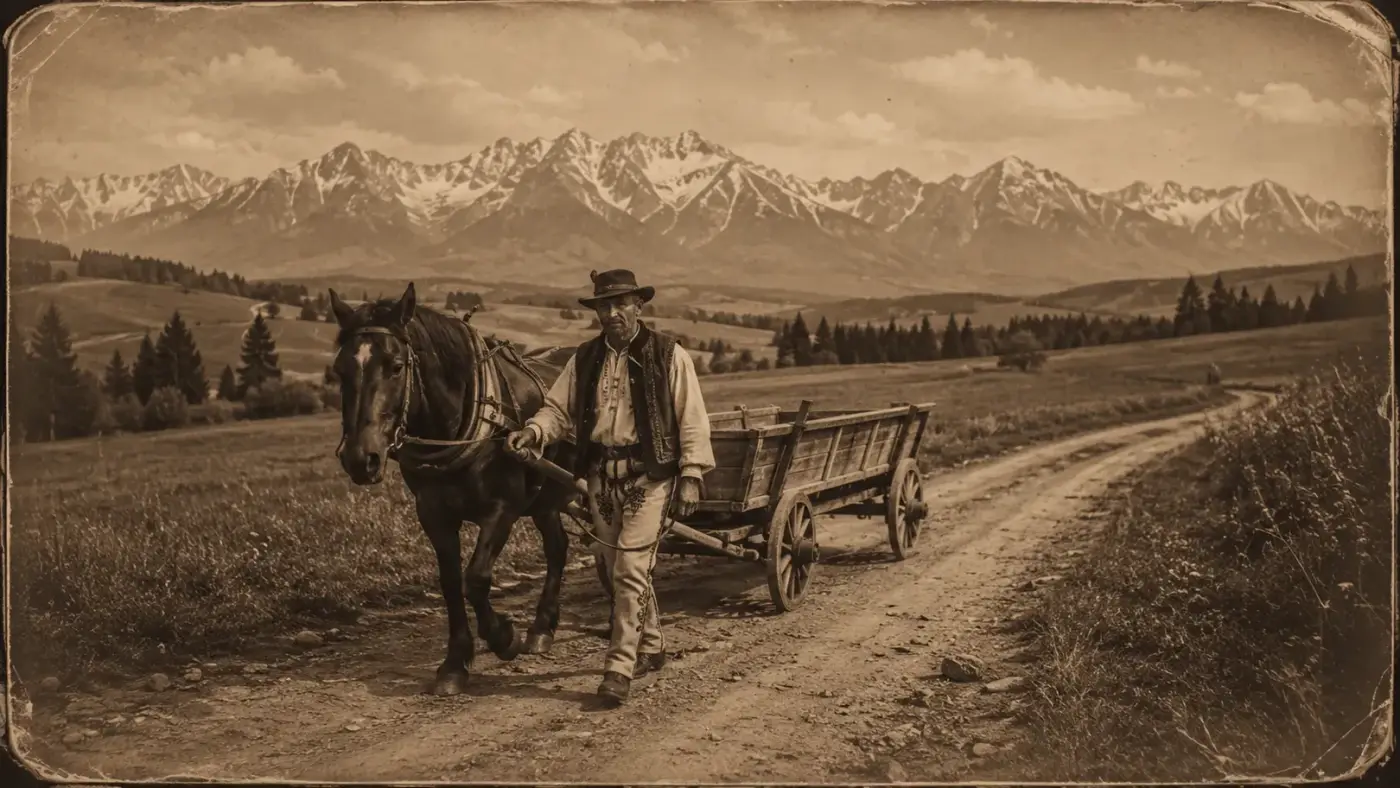
Why people used to travel to Nowy Targ for bread: the history of baking in Podhale

Blog · Kuchnia Podhala

Why people used to travel to Nowy Targ for bread: the history of baking in Podhale

For us, a loaf of bread is an everyday staple, bought just round the corner. For the highlanders of old, real bread was a rarity that one had to set out to find, usually as far as Nowy Targ. Why, in a region where food was made from what people grew themselves, did bread in particular have to be obtained from outside the home? The answer lies in the mountain climate and in the history of Podhale’s oldest market town.

Why there was no smell of bread in a highlander’s cottage

In many regions of Poland, the smell of freshly baked bread was the heart of the home. In Podhale, it was different, not out of laziness, but out of necessity.

Rye and wheat versus the mountain climate

Real bread is baked from rye or wheat. The problem was that neither of these cereals fared well in the Podhale climate: short, cool summers and poor, stony soil. The cereal that really thrived in the mountains was oats. As a result, a mountain farm rarely had its own rye flour to bake a loaf.

An oat cake instead of a loaf

Instead of fragrant, well-risen bread, the highlanders’ table was dominated by ‘moskole potato flatbreads’, or flat cakes baked on a baking tray. These served as their daily bread. The classic, sourdough loaf was therefore something of a rarity in the villages beneath the Tatra Mountains, rather than an everyday staple.

Nowy Targ: a town that is a market

Since bread and rye flour were in short supply in the mountains, they had to be obtained where trade routes converged. That place was Nowy Targ, whose very name says it all: ‘Nowy Targ’, a new place of trade.

Market privileges granted by Casimir the Great

The town’s commercial significance dates back to the Middle Ages. King Casimir the Great exempted the townspeople of Nowy Targ from Kraków customs duties and granted them permission to hold an annual fair on St Catherine’s Day, 25 November, lasting eight days. This laid the foundations for the town’s status as a trading centre in the Podhale region.

Thursday market from 1487

The greatest leap forward came in 1487. King Casimir Jagiellon confirmed the town’s rights, granted it Magdeburg law, established a second fair on St James’s Day, 25 July, and granted the privilege of holding a market on Thursdays.

A privilege that has endured for over 500 years

What is most remarkable is that the Thursday market in Nowy Targ has been held continuously to this day. It is a living testament to a privilege dating back more than five centuries. In 1533, the town’s position was strengthened by a further privilege, under which foreign merchants were not allowed to bypass Nowy Targ.

For bread, flour and salt, the real reason people went to the market

A trip to the Nowy Targ market was not a whim, but a means of stocking up on goods that the mountains could not provide.

Cereals from the lowland regions

At the market, one could buy what was lacking on a high-mountain farm: rye and rye flour from warmer, lower-lying areas, as well as salt and other essential goods. It was here that a diet based on oats could be supplemented with proper bread. The saying that people used to travel to Nowy Targ for bread thus reflects the highlander’s real economic dependence on the town at the confluence of the Biały and Czarny Dunajec rivers.

Bread as a delicacy and a symbol

Since bread was hard to come by, it was held in all the greater esteem.

Every slice was cherished

In folk culture, bread was more than just food. It was a symbol of prosperity, hospitality and blessing.

Bread fit for a feast

In places where people ate oat cakes on a daily basis, a loaf of real bread became a feature of the festive table and important occasions. Its presence signalled that the day was special.

A legacy in the kitchen to this day

The memory of this ancient value of bread has survived in regional dining culture, where respect for food remains deeply ingrained.

Pytania i odpowiedzi

Najczęściej zadawane pytania

Real bread is made from rye or wheat, but neither of these cereals fared well in the Podhale climate: a short, cool summer and poor, stony soil. The cereal that really thrived in the mountains was oats. As a result, a mountain farm rarely had its own rye flour to bake a loaf. That is why, in many highlanders’ cottages, there was simply no smell of bread.

As there was a shortage of bread and rye flour in the mountains, these had to be obtained where the trade routes converged. This place was Nowy Targ, situated at the confluence of the Biały and Czarny Dunajec rivers, whose very name means ‘new trading post’. From the Middle Ages onwards, the town served as a trading centre for the Podhale region. It was here that the highlanders stocked up on what the mountains could not provide.

King Kazimierz Jagiellończyk granted the town the privilege of holding a market on Thursdays in 1487, along with Magdeburg rights and a second market. What is most remarkable is that the Thursday market has been held without interruption to this day. It is a living testament to a privilege dating back more than five centuries. In 1533, the town’s position was strengthened by a further privilege, under which foreign merchants were not permitted to bypass Nowy Targ.

At the market, people could buy what was lacking on a high-altitude farm: rye and rye flour from warmer, lower-lying areas. They also stocked up on salt and other essential goods there. It was here that a diet based on oats could be supplemented with proper bread. The saying that people travelled to Nowy Targ for bread thus reflects the highlander’s real economic dependence on the town.

Rye and wheat require a warmer climate and better soil than Podhale had to offer. The short, cool summer and stony ground meant that these cereals did not grow well here. Oats coped much better with the mountainous conditions and became the staple crop. Consequently, there was a shortage of locally produced rye flour, and bread had to be brought in from the market.

Instead of a fragrant, well-risen loaf, the highlanders’ table was dominated by ‘moskole potato flatbreads’, flat cakes baked on a baking tray. These served as their daily bread. A classic sourdough loaf was something special in the villages of the Tatra foothills, rather than an everyday occurrence. Its presence signalled that it was a special day.

The very name of the town says it all: ‘Nowy Targ’, meaning ‘a new trading post’. It was founded at the point where trade routes converged, at the confluence of the White and Black Dunajec rivers. From the very beginning, its role was to facilitate the exchange of goods not produced by the surrounding mountains. This function has endured for centuries and remains evident to this day.

King Casimir the Great exempted the townspeople of Nowy Targ from Kraków customs duties, which facilitated trade. He also granted permission to hold an annual fair on Saint Catherine’s Day, 25 November, lasting eight days. This laid the foundations for the town’s status as a trading centre in the Podhale region. Building on this, subsequent rulers granted further market privileges.

The year 1487 saw the greatest leap forward in the commercial history of Nowy Targ. King Kazimierz Jagiellończyk confirmed the town’s rights and granted it Magdeburg rights. He also established a second fair on St James’s Day, 25 July, and granted the privilege of holding a market on Thursdays. It is this Thursday market that has continued uninterrupted to this day.

In folk culture, bread was more than just food; it was regarded as a symbol of prosperity, hospitality and blessing. As it was hard to come by in Podhale, it was held in all the more high regard. In places where people ate oat cakes on a daily basis, a loaf of proper bread became a feature of the festive table. The memory of this tradition has survived in the region’s culinary culture to this day.

Źródła i literatura

Zapraszamy do stołu

Spróbuj kuchni Podhala u źródła

Kwaśnica, oscypek z grilla, placki po zbójnicku, dania, o których piszemy, podajemy codziennie przy Kościeliskiej 8.