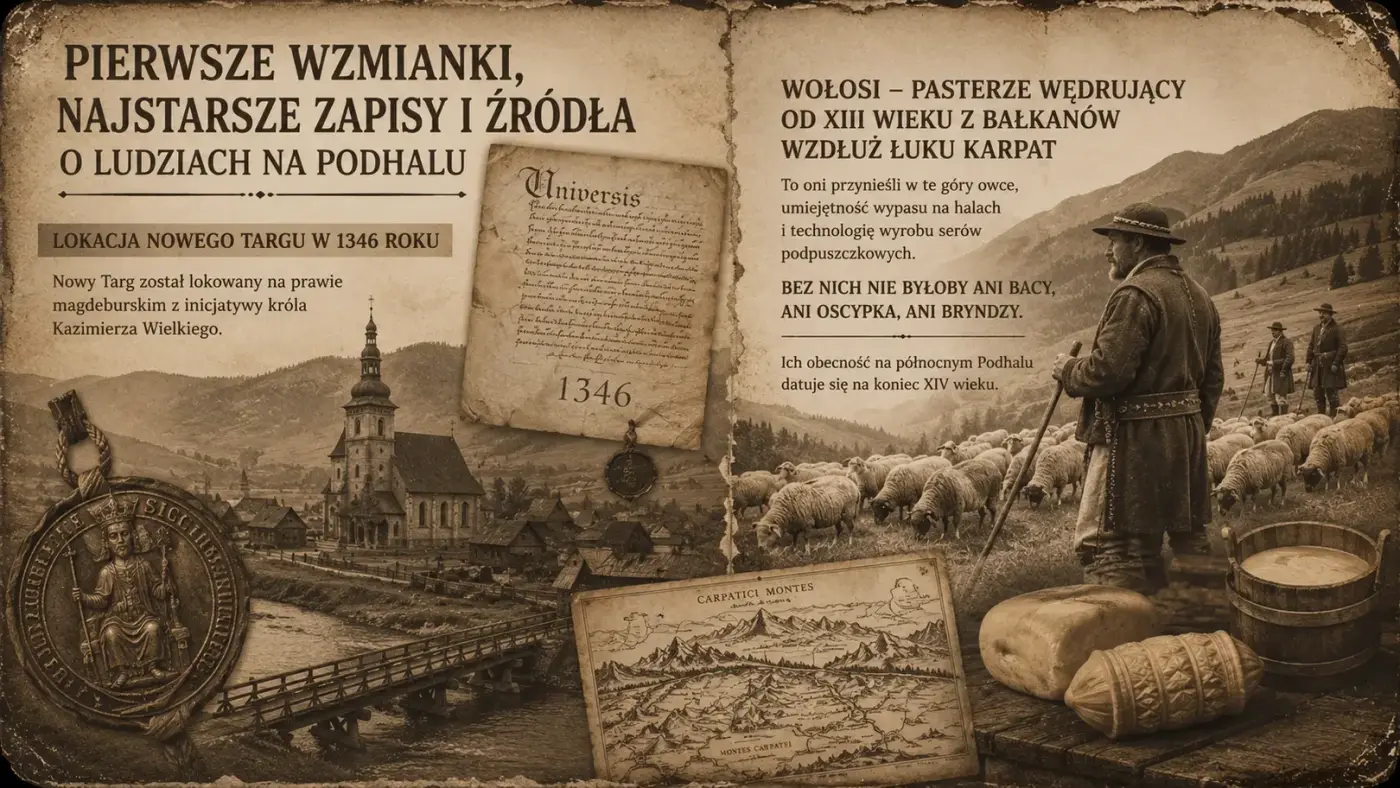
Before a regional cuisine could develop, people must have settled in Podhale
Podhale for a long time it remained a wasteland. Until the 13th century, the Carpathians were an almost uninhabited, wild expanse, and a distinct regional cuisine could not have existed before permanent settlers arrived here.
The founding of Nowy Targ in 1346
The first permanent settlement at the confluence of the Biały and Czarny Dunajec rivers was established by the Cistercians as early as the 13th century. However, the oldest certain, dated milestone is 22 June 1346, when King Casimir the Great granted the charter establishing Nowy Targ, bringing together the previously existing settlements. This is one of the oldest documented records of organised human life in this region.
The Vlachs and the arrival of sheep in the Carpathians
The second major theme concerns the Vlachs, shepherds who have been migrating from the Balkans along the arc of the Carpathians since the 13th century. It was they who brought sheep to these mountains, along with the skill of grazing on mountain pastures and the technique for making rennet cheese. Without them, there would be no ‘bacy’, no ‘oscypek’ and no ‘bryndza’. Their presence in northern Podhale dates back to the end of the 14th century.
The earliest records of highlanders’ food
Specific references to food appear gradually, and their reliability varies. Below, we have arranged them in order, from indirect evidence to a reliable, written recipe.
Tithes and poor soil as indirect evidence
Researchers cite medieval ecclesiastical decisions to reduce the tithe paid by settlers, justified by the poor, stony soil and harsh climate. This is indirect evidence, but it speaks volumes. Since the levies were reduced, the land yielded little, and the highlander’s larder was meagre. This poverty shaped the entire cuisine of the Podhale region over the centuries.
A document from Ochotnica dated 1416
A document from 1416, issued in Ochotnica, is sometimes cited in the literature; it describes the production of sheep’s cheese in a mountain hut. It is cited as one of the oldest references to cheese-making in the Carpathians.
Why we treat it with caution
The dating and interpretation of this record are debated amongst historians; therefore, we do not present it as a certainty, but as a noteworthy clue. We prefer to honestly acknowledge the uncertainty rather than provide a striking but unreliable date.
The 1748 manual and the oldest recipe for oscypek
A record from 1748 is considerably more reliable. A manual for the Ślemień estates in the Żywiec region detailed the precise method for making oscypek at that time. This is the oldest known, detailed recipe for this cheese.
A recipe that has survived for almost three centuries
Most interestingly, the production method described back then has, in essence, survived to this day. When you eat oscypek here, you are eating something that was described in black and white almost three hundred years ago. ‘oscypek sheep cheese’ itself is now protected within the European Union as a regional product, which further confirms the continuity of this tradition.
When travellers and scholars began writing about highlanders’ cuisine
The 19th century saw a veritable flood of descriptions of everyday food, as the Tatra Mountains and ‘Podhale’ were discovered by explorers and Romantics.
Stanisław Staszic and the scientific description of the Carpathians
In his 1815 work “On the Geography of the Carpathians and Other Mountains and Plains of Poland”, Stanisław Staszic described the region as a naturalist, providing one of the earliest scientific accounts of these lands and their inhabitants.
Seweryn Goszczyński and “Dziennik podróży do Tatrów”
In his “Diary of a Journey to the Tatra Mountains”, based on a trip in 1832, Seweryn Goszczyński was one of the first to describe the way of life and farming practices of the highlanders with ethnographic insight. It was he who observed that the mountain air and water greatly stimulate the appetite, so one must take a good supply of food when heading into the mountains.
Ludwik Zejszner, Władysław Matlakowski and ethnographers
Later, other researchers of Podhale culture emerged, including Ludwik Zejszner and Władysław Matlakowski.
What their works documented
Matlakowski’s works on architecture and folk equipment in Podhale, published in 1892 and 1901, describe not only the cottages but also the realities of everyday life on the farm.
Utensils and cookware of the highlander kitchen
Thanks to these descriptions, we know about the old utensils, equipment and tools used to prepare food. It is these that allow us to reconstruct what highlander cuisine was like from a practical perspective, rather than just a list of dishes.
A scholarly map of traditional food in Podhale
All this knowledge has been collected and organised by ethnographers. The foundation is the multi-volume work edited by Włodzimierz Antoniewicz, “Pastoralism in the Polish Tatra Mountains and Podhale”, as well as an earlier work by Zofia Hołub-Pacewiczowa, “Shepherd Settlements and Migrations in the Tatra Mountains and the Podtatrze Region” from 1931. Thanks to such studies, we now know what people ate in the Tatra region and why.
Remember one thing: the cuisine of Podhale did not begin with tourist inns. It began with oats, sheep and cheese, with shepherds coming down from the mountain pastures, and with a modest larder documented in dry manorial records and travellers’ notebooks. We want not only to serve this history on a plate, but also to tell its story.